
Why Fat Quality Matters to Your Heart
The Dietary Fat Guide: Why Fat Quality Matters to Your Heart
For decades, we were told to fear fat. We were encouraged to choose fat-free options and replace traditional butter with industrial alternatives like margarine or vegetable oil. However, in recent years, the conversation has changed. Research has shown that your heart actually relies on specific types of fat to function at its peak.
The High-Quality Fats Your Heart Needs
Healthy fats are the primary fuel source for your heart muscle and are essential for building strong, flexible cell membranes. Without them, your body can’t absorb critical fat-soluble vitamins like A, D, E, and K.
Monounsaturated Fats: Found in extra virgin olive oil and avocados, these help lower LDL (bad) cholesterol while supporting HDL (good) cholesterol. They are the clean-up crew for your arteries.
Omega-3 Fatty Acids: Found in wild-caught salmon and walnuts, these act as powerful anti-inflammatories. They help prevent arterial stiffness and maintain a steady heart rhythm.
Metabolic Stability: Fats slow down the absorption of carbohydrates. This prevents the rapid glucose spikes that can irritate and damage your blood vessels over time.
Heart-Health Fat Hierarchy
Not all fats are processed by your body in the same way. To support your heart and prevent the cellular damage caused by oxidative stress, you can use this ranking as a guide for your kitchen.
Here is how I rank fats for heart health:
#1 The Elite Tier
These oils are the most effective at reducing systemic inflammation and maintaining arterial elasticity as they have high anti-inflammatory potential. Use these regularly as your daily staples. Ensure you are only buying cold-pressed.
Extra Virgin Olive Oil. Very high in polyphenols and healthy monounsaturated fats.
Avocado & Oil. Excellent source of monounsaturated fats; safe for roasting and searing at high heat.
Chia seeds & Oil. A concentrated source of plant-based Omega-3s that support a steady heart rhythm.
Flaxseed & Oil. Provides a major Omega-3 boost; it’s best used as a finishing oil on cold dishes and should never be used for cooking.
Raw Walnuts & Oil. Contains a specific nutrient profile that helps the lining of your blood vessels function better.
#2 The Quality Tier
These nutrient-dense options provide essential fatty acids. These are heart-healthy, stable and minimally processed, but just have fewer of the specialized compounds found in the elite tier. Complement your Elite Tier with these! Ensure you are only buying cold-pressed.
Canola Oil. When cold-pressed or expeller-pressed, it keeps its natural Vitamin E and a healthy balance of fats.
Camelina Oil. An ancient grain oil from the Prairies that is naturally stable and high in Vitamin E.
Hemp Seed Oil. Offers a great balance of Omega-6 to Omega-3, which helps manage inflammation.
Almond Oil. A high-monounsaturated oil that is a significant source of antioxidants.
#3 The Whole-Food Saturated Tier
These are natural, whole-food sources of saturated fat.
Disclaimer: It is still important to remember that just because a fat is natural does not mean it should be consumed without caution, especially saturated fats. While they are much better for you than industrial spreads and oils, they are higher in saturated fats and should be used as secondary options mainly to add or enhance flavour.
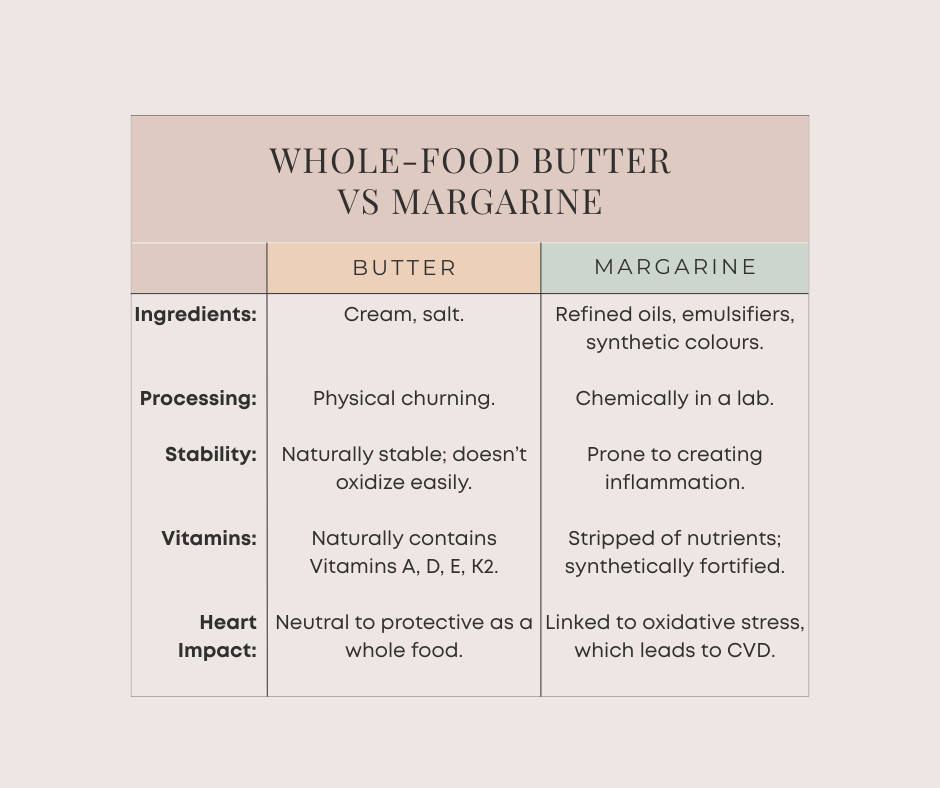
Grass-fed butter. A traditional fat that is produced with minimal ingredients (usually just cream and salt) through the physical process of churning. Butter contains butyrate, which is beneficial for both your gut and your heart, and naturally contains Vitamins A, D, E, and K2. In fact, recent large-scale reassessments on the causes of heart disease have found that when consumed as part of a whole-food diet, the saturated fat in butter is not the direct heart-health villain it was once thought to be, especially grass-fed. Why do I praise grass-fed? Grass-fed butter is significantly more anti-inflammatory because it contains up to five times more Conjugated Linoleic Acid (CLA) and a much healthier ratio of Omega-3 to Omega-6 fatty acids than conventional butter.
Unrefined coconut oil. This one is a bit of an outlier. Because it is rich in MCTs (medium chain triglycerides), it is great for quick metabolic energy. However, because it is so high in saturated fat (higher than butter), it can raise your LDL (bad) cholesterol. Use sparingly for flavouring (like in a Thai curry or for high-heat baking).
#4 The Avoid Tier
These highly refined industrial fats are unstable and highly processed and can drive inflammation and oxidative stress which is associated with heart disease.
Highly Refined Vegetable Oils. such as soybean, corn, cottonseed. These are usually processed with high heat and chemical solvents.
Margarine. Chemically engineered through a process in a lab called interesterification (more on that below).
Lab-Processed Canola Oil. This is the standard clear yellow canola oil found in grocery stores, not the cold-pressed specialty variety. Because it is RBD (refined, bleached, and deodorized (GROSS!) at high temperatures, the natural nutrients of the canola seeds are stripped away, and the oil becomes more inflammatory and less stable.
Shortening. Involves the highest level of industrial processing and molecular changes.
Pro-Tip on Storage and Stability: Oils like chia, flax, walnut, hemp are delicate and can spoil if they are exposed to too much heat or light. To prevent them from becoming rancid (which causes inflammation), keep these specific oils in the fridge. Do not use them frying; instead, drizzle them over your food after it has finished cooking or use in dressings.
Click here to download the Fat Hierarchy Cheat Sheet
More on Margarine
Sorry margarine-lovers. I know many of you out there love the convenience and believe that it’s healthier than butter because it’s not a saturated fat. We were led to believe that for literally decades. This is NOT a shaming exercise at all. I get it. I used to be right there with you! But what I’ve learned through my education as a Holistic Nutritionist, and through many articles and research tells a different story and my goal is just to share a bit of this information with you so you don’t have to go through all the exciting research papers and articles youself!
Many of us grew up with margarine on the table, believing it was the heart-healthy choice. While it has definitely improved significantly over the years, when we look at the actual ingredients and processing of common modern day margarine brands, it still causes me concern. Here’s why: it is simply not real food. It’s not natural, it is completely manufactured using fake flavouring, additives, deodorizers, colours, chemicals, emulsifiers, preservatives, etc. just to mimic an actual real food, butter.
Do You Know What is in Your Margarine?
Most of that plastic container of yellow spread is comprised of inflammatory highly processed (not cold-pressed) vegetable oils (from category #4 above). But it’s in a liquid form, so it needs to go through extra chemical processing to change the consistency to a spreadable solid form.
Common Additives Include:
Artificial Colour: Vegetable oils are naturally white or pale, so manufacturers add colourants to make the product look more yellow like butter.
Emulsifiers: These also help to blend the water and oil to ensure that smooth, spreadable texture that margarine is famous for.
Preservatives: Margarine requires preservatives because it is often a lower-fat, water-in-oil emulsion so is susceptible to microbial growth (mold and yeast) and oxidation.
Flavourings: Since the base of margarine is vegetable oil and water, artificial flavourings like diacetyl, acetylpropionyl, or acetoin are added to mimic the taste of butter and to cover the synthetic taste left by the processing. Milk or buttermilk solids are sometimes added in the non-vegan varieties as well. Without the flavourings, margarine would not be very palatable.
Vitamins: Often margarine is fortified with vitamins A and D because the ingredients used to manufacture it are stripped of nutrients.
Label Loopholes
Most common margarines are composed primarily of refined vegetable oil (from category #4 above). While they often claim 0g trans fats, Canadian labelling laws allow companies to round down to zero if there is less than 0.2g per serving. Because these oils are refined at extreme heat, small amounts of trans fats can still be created, meaning 0g doesn't always mean zero.
What happens in the Lab (Interesterification)
The convenient spreadable texture of margarine is achieved through a chemical process called interesterification. Scientists use this chemical process to shuffle the branches of fat molecules into new, lab-created positions to change the oil's consistency, hence making it spreadable rather than liquid. While this process avoids the dangerous hydrogenation of the past, it results in a highly engineered fat that is structurally different from what our bodies have relied on for thousands of years.
What the Research Says
Historically, long-term studies like the Framingham Heart Study found that margarine consumers had a higher risk of heart disease than butter eaters. While much of that risk was caused by the trans fats due to the partially hydrogenated oils used in the past, it sparked a major turning point. Thankfully partially hydrogenated oils have been largely phased out or banned altogether and replaced by the interesterification process. But even with the reduction of trans fats, this article still taught us that the quality and processing of the fat (how it is handled in a lab versus how it occurs in nature) is more important than whether it came from a plant or an animal.
Side-By-Side Comparison of Butter and Margarine
Shannon’s Kitchen Tip: Make Your Own Spreadable Butter Blend at Home. It is SO easy!
If you love real butter but you miss the convenience of spreadable margarine, you can make your own spreadable butter at home. This method uses a rapid-chill technique to create a fluffy, whipped texture that stays spreadable right out of the fridge.
Click here to download the printable recipe

A Love Letter to the Land: Why Processing is Everything
I live in the land of living skies where in the summer months you can see miles and miles of beautiful bright yellow canola fields in all directions. I have many friends and family members who are canola farmers, and I have the utmost respect for the hard work that goes into every harvest. My goal is to see our local crops treated with the respect they deserve.
The problem is not the seed; it’s the factory! Canola is naturally high in plant-based anti-inflammatory Omega-3s and heart-loving monounsaturated fats. However, the industrial RBD process of Refining, Bleaching, and Deodorizing uses chemical solvents and extreme heat that can destroy these delicate nutrients.
I am advocating for real, minimally processed oils that support our local farmers and our heart health. When a seed is cold-pressed, its natural vitamin E and healthy fats stay intact.
Some Canadian Producers of Cold-Pressed Canola Oil
North Prairie Family Farms (Saskatoon, SK): northprairiefamilyfarms.com
Highwood Crossing Foods (High River, AB): highwoodcrossing.ca
Pleasant Valley Oil Mills (Clive, AB): pleasantvalleyoilmills.com
Maison Orphée (Québec): Find them in retailers via maisonorphee.com
Further Reading & Clinical Research
If you are a data nerd like me and interested in the research behind these heart-health shifts, here are the key studies to explore:
On Saturated Fat Reassessment: Saturated Fats and Health: A Reassessment and Proposal for Food-Based Recommendations (Journal of the American College of Cardiology, 2020). This review highlights that dairy fat is often neutral or even protective for heart health. Read the Study Here
On Oxidized Oils: Omega-6 vegetable oils as a driver of coronary heart disease (Open Heart, 2018). This study explores how unstable, refined industrial oils contribute to heart disease through inflammation. Read the Full Open Access Paper
On Cold-Pressed Benefits: Cold-pressed rapeseed (Brassica napus) oil: Chemistry and functionality (ScienceDirect). This comprehensive review confirms that cold-pressing (mechanical extraction at low temperatures) preserves tocopherols (Vitamin E), phenolics, and sterols that are typically lost or reduced during the high-heat refining, bleaching, and deodorizing (RBD) process. Full Article Access via ScienceDirect
